For Anyone Looking To GET PAST 1200 ELo
Cut Your Blunder Rate In Half In 30 Days By Following A Simple Four-Step Checklist Before Every Move
Without memorizing complex opening theory, grinding through hours of endgame studies, or trying to think 10 moves ahead
What is the Pre-Move Protocol?
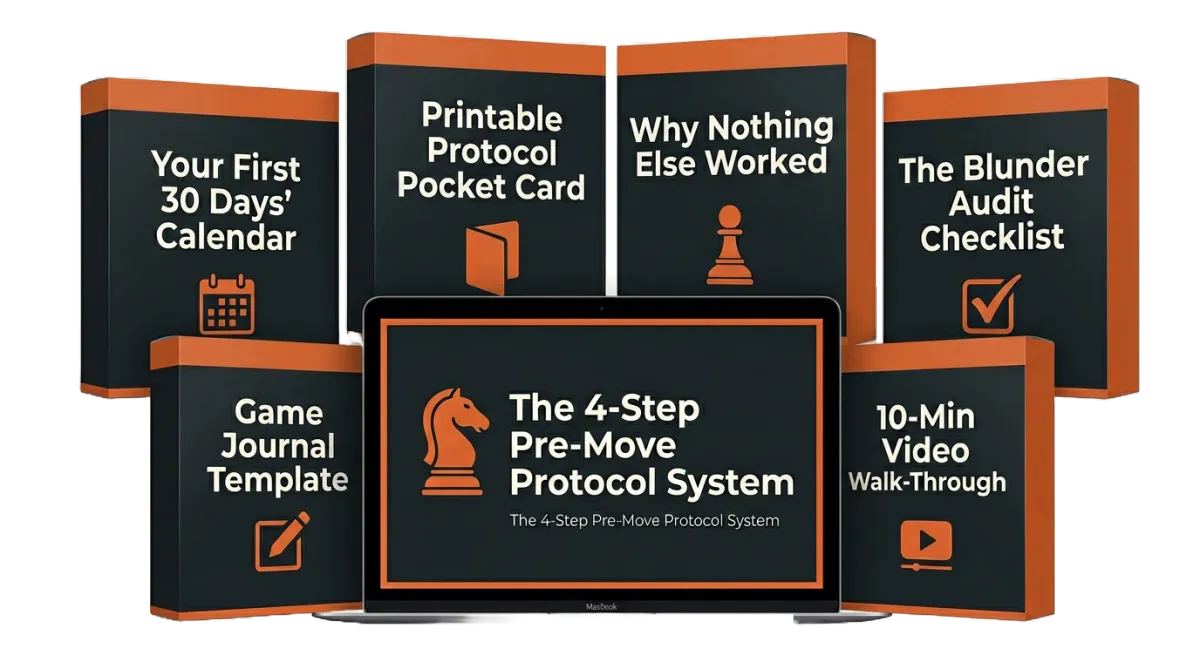
The Pre-Move Protocol is a 4-step chess protocol you can use before every move allows you to sit down at the board feeling like YOU'RE the one in control, catch the mistakes before they happen, and finally play the chess you're capable of playing...
....without drowning in theory you'll never use, spending 6 hours a day studying positions you'll never see, or trying to calculate like a computer.
We achieve this by teaching your brain to scan the board like a grandmaster — seeing the whole picture in seconds, not struggling through move-by-move guesswork — without adding MORE complexity to your thought process or forcing you to memorize endless lists of patterns.
And as a result, this frees you up to actually ENJOY playing again, stop feeling like an idiot every time you lose, and be the guy your chess friends ask "wait, how did you get this good?"
This is The Pre-Move Protocol.
NOW AVAILABLE FOR
INSTANT DIGITAL DOWNLOAD
Only $97.00 $19
Save $78.00 today
Download The eBook For $327 Just $19! Delivered instantly. Start reading in the next 2 minutes.
Now Available For Instant Download
100% secure 256-bit encrypted checkout

Excellent based on multiple reviews

The Pre-Move Protocol Is A Shortcut To Winning More Games By Eliminating Blunders
Look, before I created the Pre-Move Protocol...
I was stuck in the same frustrating loop you're probably in right now:
Grinding through beginner courses...
Drilling tactics for hours...
Studying openings until my brain felt like mush...
Watching YouTube videos from every "chess personality" promising rapid improvement...
And despite all that effort...
I was STILL hanging pieces, missing obvious tactics and feeling like I was playing blind.
It didn't make sense.
I was doing everything the "right" way...
So why wasn't it working?
That's when I realized...
The traditional approach to getting better at chess is totally broken.
It overloads your brain with information you can't actually USE during a real game.
So I threw out the rulebook...
Stopped trying to memorize everything...
And instead asked a different question:
"What's the MINIMUM my brain needs to process... to stop making stupid mistakes?"
After years of testing...
Trial and error...
Figuring this out the hard way...
I finally cracked it.
A simple 4-step system that I could run through EVERY position...
That allowed me to play entire games without a single major blunder...
Spot moves I used to miss completely...
And actually UNDERSTAND what's happening on the board instead of just hoping for the best.
Now...
You have the opportunity to use the EXACT same system I built.
It's called the Pre-Move Protocol - and it's available for just $19.
Here's how it works:
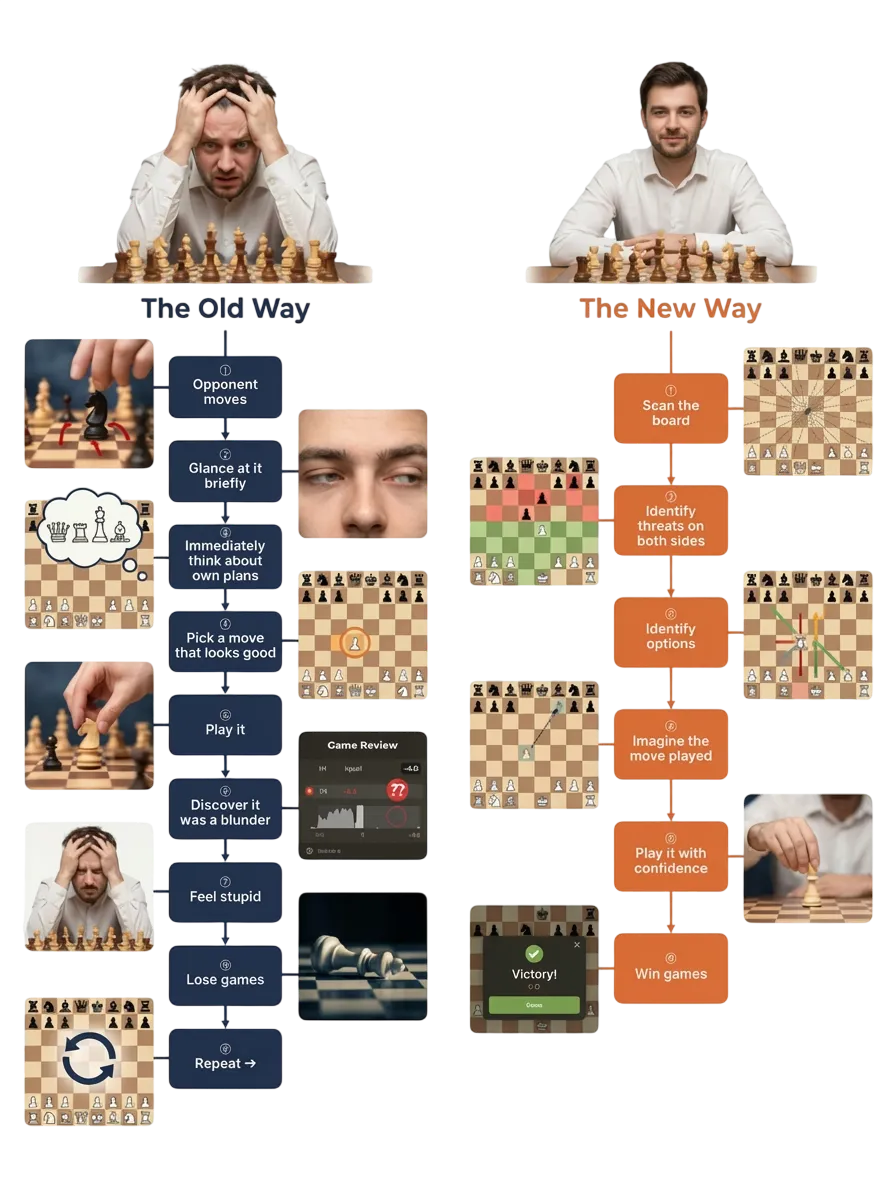
You're Not Bad At Chess. Your Brain Is Just Overloaded.
And I'm about to show you a stupidly simple 4-step system that will eliminate the blunders costing you 200+ rating points FAST:
Because it's a pattern-recognition training system that's backed by 80+ years of cognitive research…
That'll allow you to see threats clearly, spot winning tactics faster, and calculate moves ahead without mental fog.
And as a result, you'll win more games, you'll beat players at your level more reliably, and you'll finally break through your current plateau…
…without grinding through endless study, memorizing opening lines for hours, or doubting yourself on every single move.
Now...
Before I walk you through this system...
I need to address something.
Because if you've been playing chess for a few weeks or a few years...
And you're stuck somewhere below 1200 ELO...
Watching your rating bounce up and down like it has a personal vendetta against you...
You've probably said some version of this to yourself:
"What the hell is wrong with me?"
You study tactics.
You watch YouTube videos.
You know the principles.
"Control the center." "Develop your pieces." "Don't move the same piece twice."
You can probably solve puzzles rated 200-300 points HIGHER than your actual game rating.
But then you sit down to play...
And within 10 moves, you've hung a knight.
Or walked into a fork.
Or pushed a pawn for no reason and now your king is getting mated.
Or — if you're rated higher — you play 15 solid moves of opening theory...
Your prep runs out...
And you have no idea what to do next.
So you blunder a piece while trying to figure out a plan…
And you stare at the screen thinking...
"I KNEW better than that. Why did I do it anyway?"
Well, I can tell you with absolute confidence why:
It's not because you're stupid.
It's not because you lack talent.
It's not even because you're not studying enough.
It's because...
you're trying to think your way through chess When You should be training your brain to SEE it.
Let me explain.
When you sit down to play a game...
Your brain is trying to juggle:
> What your opponent just did
> What threats they're creating
> What YOUR best move is
> Whether you're hanging any pieces
> What opening you're supposed to be playing
> Whether you should trade or not
> If there's a tactic you're missing
> How much time is left on the clock
That's EIGHT different things - all at the same time.
And here's the problem...
Your brain can only hold about 3-4 things in working memory at once.
So what happens?
You forget to check if your queen is hanging.
Or you see a cool attack... but miss that it hangs your rook.
Or you're so focused on your plan that you completely miss theirs.
This isn't a "you" problem.
It's a chunking problem.
And every player under 1200 has it.
The difference between YOU and a 1500-rated player?
They're not processing more information.
They're processing it DIFFERENTLY.
They're not smarter or more talented than you.
Their brains just WORK differently when they look at a chess position.
And I can prove it to you right now.
In 1973, Two Scientists Figured Out Why Experts Are Better At Chess
Their names were William Chase and Herbert Simon.
And they ran an experiment that changed everything we know about chess improvement.
They took three players:
→ A Master (around 2200 rating)
→ A Class A player (around 1800)
→ And a Beginner (around 1000)
Then they showed each of them a real chess position.
For just 5 seconds.
After that, they took the board away...
And asked them to recreate the position from memory.
Here's what happened:
The Master remembered about 16 pieces and their exact locations.
The Class A player remembered about 8 pieces.
The Beginner? Only about 4 pieces.
At first glance, this seems obvious, right?
Better players have better memory.
But then Chase and Simon did something clever
They Showed The Same Players Random Positions
Pieces placed with no logic.
No real game structure.
Just... chaos.
And guess what happened?
The Master did NO better than the Beginner.
They BOTH remembered about 4-5 pieces.
The expert advantage completely disappeared.
So what does this tell us?
Masters don't have better memories.
They see the board DIFFERENTLY.
When a Master looks at a position...
They're not seeing 25 separate pieces.
They're seeing GROUPS of pieces working together.
Big connected patterns.
Chase and Simon called these "chunks."
And here's the key insight:
Everyone Can Hold About 7 Chunks Of Information In Their Head At Once.
That's just how human brains work.
But the size of each chunk is different depending on your skill level.
A Master's chunks contain about 4-5 pieces each.
So when they look at a middle game position with 25 pieces...
They're seeing it as about 5-7 big chunks.
Totally manageable.
A Beginner's chunks?
Often just 1 piece each.
So that same 25-piece position?
You're seeing it as 25 separate things.
And your brain can only track 7 of them before it's completely FULL.
The other 18 pieces are basically invisible.
That's why you hang pieces.
Not because you're bad.
Because your brain literally CAN'T see them all at once.
And Here's Where It Gets Even More Interesting
In 1946, a scientist named Adriaan de Groot ran a similar experiment.
He showed chess positions to players ranging from beginners to world champions.
For just 3-5 seconds.
Then asked them to recreate it.
Grandmasters got 93% of the pieces right.
Beginners? Only 51%.
But the REALLY interesting part?
De Groot also asked the players to think out loud while they were deciding on moves.
And he discovered something that should change how you think about improvement:
Grandmasters didn't calculate MORE moves than weaker players.
They didn't even consider MORE candidate moves.
In fact, they often looked at FEWER options.
But the moves they DID consider?
They were the RIGHT moves.
Because their pattern recognition was so good...
They could instantly FILTER OUT the bad moves...
And only focus on the ones that actually mattered.
Beginners, meanwhile, were wasting mental energy...
Calculating lines that were obviously bad.
Or missing threats entirely because their brain was too full.
So here's what we know from the research:
1) Experts see positions as big connected patterns (chunks), not individual pieces
2) This frees up their working memory to actually THINK about the position
3) Better pattern recognition means they waste less time on bad moves
4) This creates a compounding effect where they improve faster
Okay.
So now we know WHY experts are better.
But here's the problem...
How Are YOU Supposed To Build Those Patterns?
Because here's the trap most players get stuck in:
No patterns → brain overload → no space to learn → no new patterns → stuck forever.
You can't build pattern recognition by "playing more games"...
Because you're making too many mistakes to learn anything useful.
You can't build it by "doing more puzzles"...
Because here's the dirty secret about puzzles:
In a puzzle, you KNOW there's a tactic to find.
The puzzle tells you "something brilliant is here — find it."
In a real game?
Nobody taps you on the shoulder.
You have to know WHEN to look, not just WHAT to look for.
That's why your puzzle rating can be 200, 400, even 800 points higher than your game rating...
And it STILL doesn't transfer.
Your brain can find tactics in puzzle mode.
It just can't activate that same skill during a game...
Because it's drowning in everything else.
And you definitely can't build it by "studying openings"...
Because now you're adding EVEN MORE information on top of everything else your brain is already drowning in.
And worse...
If you're the type who memorizes 10-15 moves of theory...
You're training your brain to follow a script instead of evaluate a position.
So the moment your prep runs out?
Your thinking process has no foundation to fall back on.
That's why players who "know openings" still blunder in the middlegame.
So what do you do?
Well...
The answer from the question I started asking.
What If You Could Train Pattern Recognition WITHOUT Overloading Your Brain?
My name's David Smith.
And I'm not a grandmaster.
I'm not even close.
What I AM is someone who got obsessed with a question:
If cognitive scientists figured out exactly how chess experts think — decades ago — why is every beginner still getting the same useless advice?
"Do puzzles." "Analyze your games." "Play longer time controls."
That advice isn't wrong.
It's just incomplete.
It tells you WHAT to do but never HOW to think.
So I went to the source:
I read de Groot's original research on expert thought processes…
I studied Chase and Simon's chunking experiments…
I dug into Ericsson's work on deliberate practice…
I read Sweller's cognitive load theory…
And I realized something that should have been obvious:
The research already tells us exactly HOW experts process positions - And Anyone Can learn Them
Step by step.
In order.
Nobody had just... written it down as a system a normal player could follow.
So that's what I built.
I reverse-engineered the expert thinking process into 4 sequential steps.
Simple enough to follow during a game.
Structured enough that your brain doesn't overload.
And designed so that with repetition, the steps compress into automatic chunks...
Exactly like the research predicts.
Then I brought it to Andreas Toth.
Andreas is a 2000-rated tournament player who's coached dozens of students from beginner to intermediate level.
I didn't want validation.
I wanted someone who'd tear it apart if it didn't hold up.
Instead, he started using it with his students:
Players rated 500 who were hanging pieces every game…
Players rated 1100 who were solid in the opening but collapsed the moment their prep ran out…
Players with 1600 puzzle ratings who couldn't find the same tactics in real games…
The same protocol worked across all of them…
Because it doesn't teach you chess knowledge.
It teaches you the THINKING PROCESS that makes chess knowledge usable.
That's the Pre-Move Protocol.
Here's How The Pre-Move Protocol Works
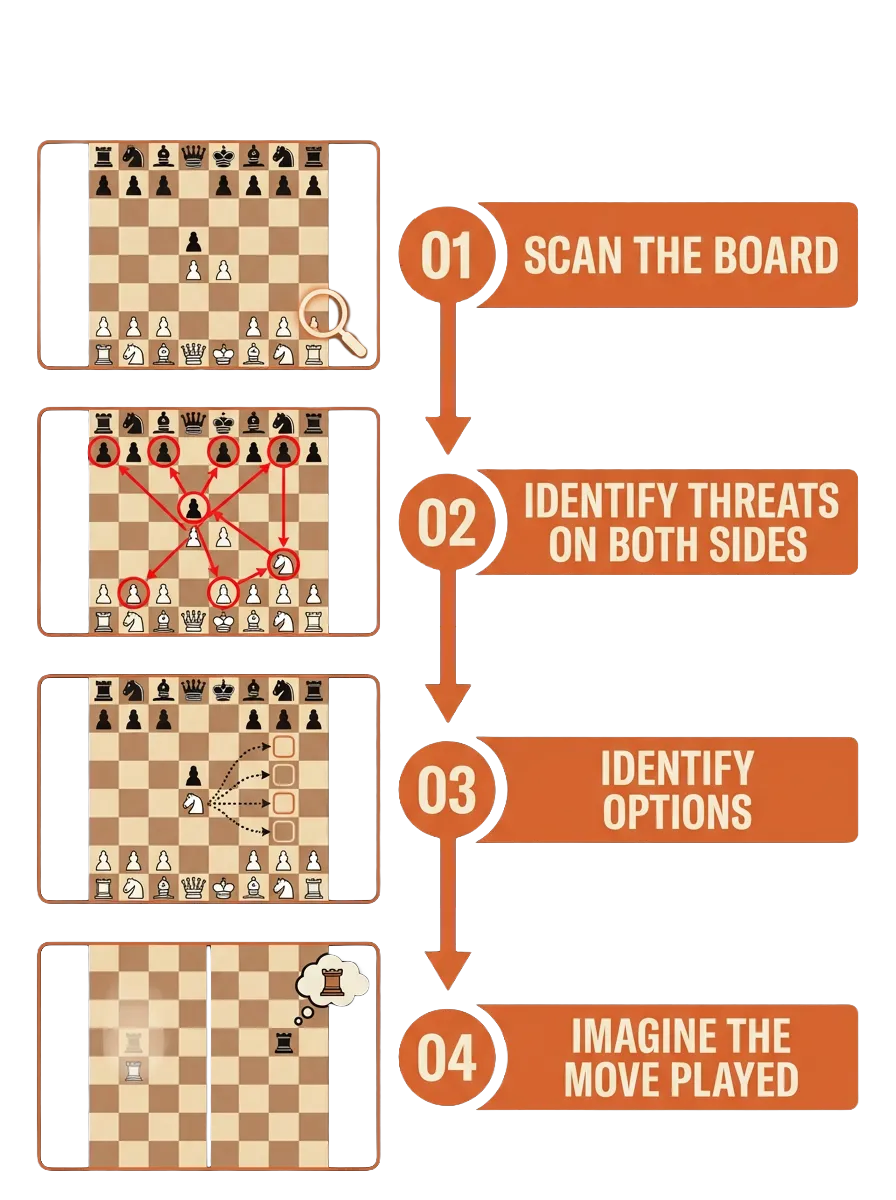
Because by following the 4 steps...
You're not asking your brain to track everything at once.
You're focusing on ONE pattern at a time.
→ Scan. Just threats.
→ Secure. Just your pieces.
→ Spot. Just opportunities.
→ Simulate. Just consequences.
And over time?
These become AUTOMATIC.
Your brain starts CHUNKING them together.
Suddenly "Scan + Secure" becomes one automatic check.
Then "Spot + Simulate" become one fluid thought process.
And now you've freed up working memory...
To think about BIGGER ideas.
Plans...
Strategy...
Deeper tactics...
This is how you build pattern recognition without overloading your brain.
You're not trying to memorize positions.
You're training the PROCESS experts use to evaluate positions.
And the patterns emerge naturally from that.
This Isn't One Person's Opinion. It's 80 Years of Cognitive Science, Applied.
Let me be direct about something.
This system isn't based on one person's chess journey or one coach's opinion.
No.
It's based on decades of peer-reviewed research into how expert chess players actually think:
Adriaan de Groot (1946) studied world champions and amateurs side by side.
His finding: experts don't calculate deeper — they recognize patterns faster, which lets them filter out bad moves instantly.
William Chase & Herbert Simon (1973) proved that chess expertise isn't about memory or intelligence — it's about "chunking."
Experts see groups of pieces as single units.
Beginners see individual pieces.
Same brain.
Different organization.
K. Anders Ericsson (1993) established the framework for deliberate practice — the idea that improvement comes from structured, focused training with immediate feedback.
Not from playing thousands of games on autopilot.
Fernand Gobet & Herbert Simon (1996) extended the chunking research and showed that Masters store roughly 100,000 chunk patterns.
But — and this is the critical part — those chunks are built through a PROCESS of structured evaluation, not passive exposure.
Cognitive Load Theory (Sweller, 1988) explains why studying MORE often makes you WORSE.
When your working memory is maxed out, you can't form new long-term memories.
You're just spinning.
That's not a blog post I read…
That's not something I saw on chess Twitter…
Those are published, replicated studies spanning five decades.
The Pre-Move Protocol takes those findings and turns them into something you can actually USE.
A step-by-step process that:
✓ Reduces cognitive load (Sweller) so your brain can actually learn
✓ Forces structured evaluation (Gobet & Simon) so chunks form naturally
✓ Mirrors how experts filter positions (de Groot) so you stop wasting mental energy
✓ Creates deliberate practice in every game you play (Ericsson) — not just when you're "studying"
This isn't my theory.
It's their research.
I just built the protocol around it.
This Isn't One Person's Opinion. It's 80 Years of Cognitive Science, Applied.
And you're right.
At 2000 ELO, yeah, you need deeper calculation, more sophisticated pattern recognition, more openings, more endgame tactics.
But at your level?
Whether you're 400 or 1200...
Whether you've been playing for three weeks or three years...
Whether you play 15-minute rapid or 3-minute blitz...
You don't need to play like a grandmaster.
If you're 500, you need to stop hanging pieces.
If you're 800, you need to stop missing simple tactics that you'd find instantly in a puzzle.
If you're 1100, you need a thinking process for the moment your opening prep runs out and you're on your own.
The Pre-Move Protocol handles all three.
It gives you the SAME mental framework grandmasters use subconsciously...
But broken down into four steps simple enough that anyone can actually follow them.
Without overloading.
So you can start building the patterns you NEED...
To get to the next level.
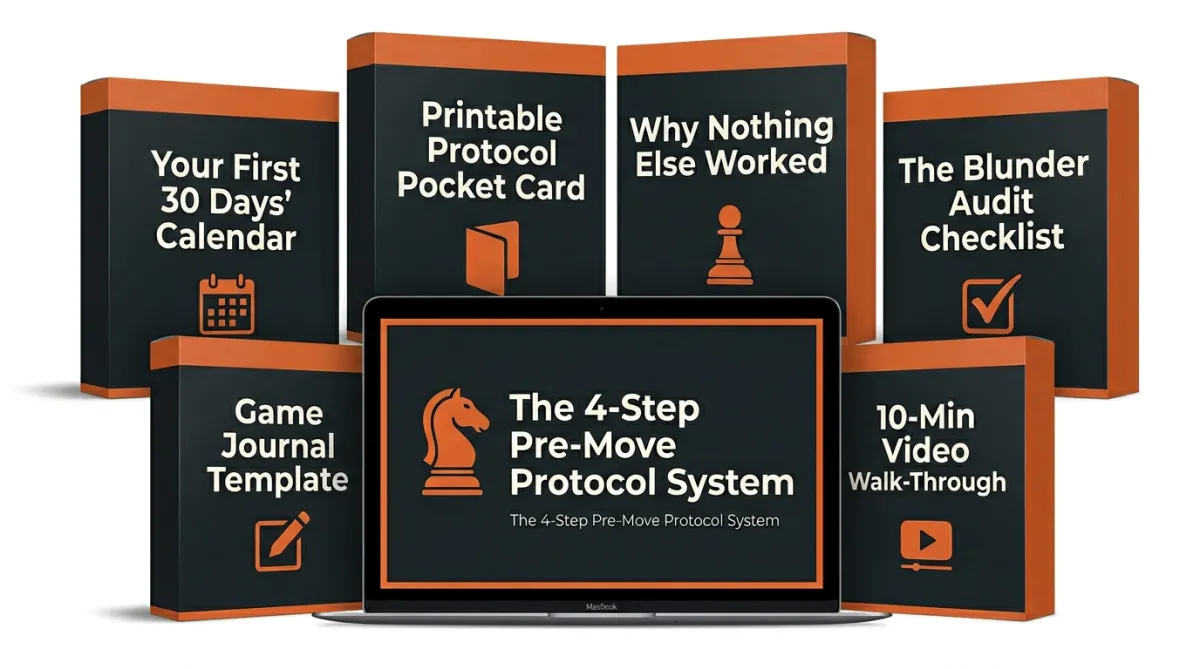
Here’s Everything Included:
8 bonuses included today
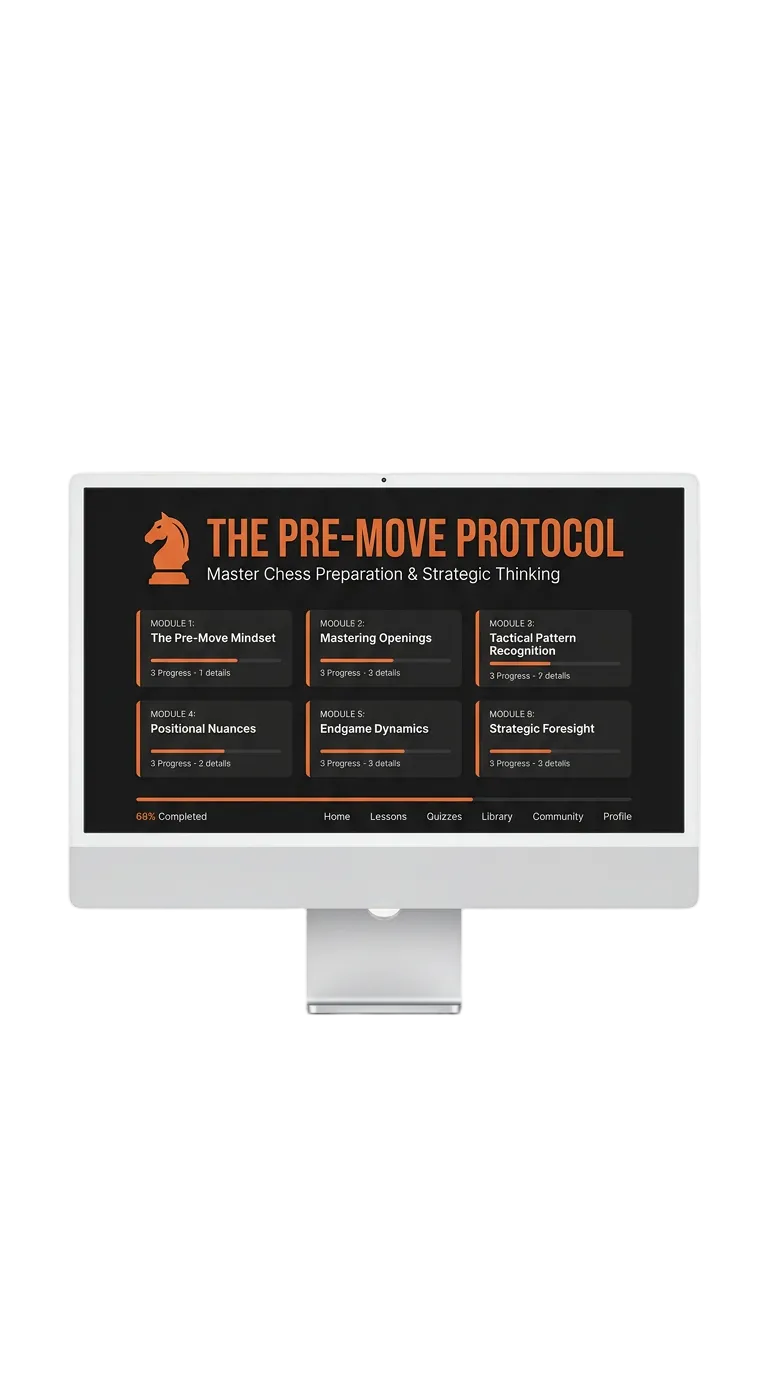
THE PRE-MOVE PROTOCOL
The complete system — reverse-engineered from 80 years of cognitive science research into how Grandmasters actually think.
INSTANT ACCESS | Price: $37 $19
Your First 30 Days' Calendar
A day-by-day roadmap that tells you exactly what to do — and when.
INSTANT ACCESS | Price: $37 FREE
Printable Protocol Pocket Card
The entire 4-step system on a single card. Print it. Laminate it. Prop it next to your monitor or your physical board
INSTANT ACCESS | Price: $37 FREE
The Crash Protocol
A step-by-step intervention for the moment your brain stops following the system and starts chasing revenge.
INSTANT ACCESS | Price: $37 FREE
Game Journal Template
A printable one-page-per-game journal that tracks the thing your rating doesn't show: whether you're following the process.
INSTANT ACCESS | Price: $37 FREE
The Blunder Audit Checklist
A printable checklist you run through after every game.
After 10 games, you'll know exactly which step breaks down under pressure — and you'll know exactly what to drill.
INSTANT ACCESS | Price: $37 FREE
Only A Few Days Left
Only $97.00 $19
Save $78.00 today
Download The eBook For $97 Just $19! Delivered instantly. Start reading in the next 2 minutes.
Now Available For Instant Download
100% secure 256-bit encrypted checkout
Excellent based on multiple reviews
Based on studies from





Limited Time Special - Download The Digital Version For Only $19
The Only System You’ll Ever Need To
Stop Blundering Games
We packed everything we've learned into this guide. All the patterns and mental frameworks that actually move the needle for players who keep making the same mistakes. All the cognitive research we dug through so you don't have to. So you get to skip straight to what WORKS... and avoid all the dead-end study methods that keep most players stuck.
Click Here To Download The Pre-Move Protocol
Backed By Our Unconditional 60 Day Money Back Guarantee
Here's Everything You're Getting
For Only $19 Today
The Pre-Move Protocol
(Digital PDF Download)
The complete system — reverse-engineered from 80 years of cognitive science research into how Grandmasters actually think.
INSTANT ACCESS | Price: $37 FREE
Bonus #1: "Your First 30 Days" Calendar
(Digital PDF Download)
A day-by-day roadmap that tells you exactly what to do — and when.
INSTANT ACCESS | Price: $37 FREE
Bonus #2: Printable Protocol Pocket Card
(Digital PDF Download)
The entire 4-step system on a single card. Print it. Laminate it. Prop it next to your monitor or your physical board.
INSTANT ACCESS | Price: $37 FREE
Bonus #3: The Crash Protocol
(Digital PDF Download)
Most players lose 50-100 rating points in a single tilt session that should've ended three games ago. This protocol catches you before the spiral starts — so one bad game stays one bad game, not five.
INSTANT ACCESS | Price: $37 FREE
Bonus #4: Game Journal Template
(Digital PDF Download)
A printable one-page-per-game journal that tracks the thing your rating doesn't show: whether you're following the process.
INSTANT ACCESS | Price: $37 FREE
Bonus #5: The Blunder Audit Checklist
(Digital PDF Download)
A printable checklist you run through after every game. After 10 games, you'll know exactly which step breaks down under pressure — and you'll know exactly what to drill.
INSTANT ACCESS | Price: $37 FREE
Click Here To Download The Pre-Move Protocol Now
Backed By Our Unconditional 60 Day Money Back Guarantee

Your Purchase Is Backed By Our Unconditional Money Back Guarantee
Look...
I know that before I get into anything… I'd like to know what I'm ACTUALLY buying.
And that if it doesn't work out... I'm not stuck with it.
So I want you to be comfortable with this purchase.
Even though it's only $19...
That's still YOUR money.
You earned it. It counts.
My grandpa used to say "Test drive the car before you drive it off the lot"…
(He also said a bunch of other wildly inappropriate things... but we'll skip those for now.)
Point is...
Here's what I've arranged:
Grab The Pre-Move Protocol.
Read it.
And more importantly... APPLY it in your next few games.
See if it actually helps you stop blundering and start winning.
If you're not happy with it...
Or if you feel like it didn't deliver on what I promised...
Just email info@featherway-publishing within 60 days.
We'll refund your $19.
No hassle. No questions asked.
AND you can keep the guide.
So either way, you win.
Either you finally break through your plateau...
Or you get free chess training.
Fair enough?
Frequently Asked Questions
Need help? [email protected]
I want this, what exactly am I getting?
You're getting instant access to the complete Pre-Move Protocol system.
That includes the full 4-step checklist you'll use before every move...
A breakdown of exactly HOW to apply each step in different position types...
Real game examples showing the Protocol in action...
Common mistakes people make when implementing it (and how to avoid them)...
Plus a quick-reference guide you can keep open during your games until the system becomes automatic.
Everything you need to cut your blunder rate in half within 30 days.
Do you offer more in depth help?
Yes.
The Pre-Move Protocol gives you everything you need to start eliminating blunders immediately.
But if you want personalized feedback on YOUR games...
Or help troubleshooting specific positions where you're still struggling...
We offer opportunities to upgrade after purchase.
We also have a private coaching program (by application only) if you want hands-on help implementing the system at a deeper level.
Who is this for?
This is for anyone rated below 1200 who's tired of hanging pieces and missing obvious tactics.
If you've been playing for a few weeks or a few years...
And you're frustrated because you KNOW you should be better by now...
But you keep making the same careless mistakes...
This is for you.
It doesn't matter if you're a complete beginner or someone who's been stuck at the same rating for months.
The Pre-Move Protocol works because it's based on how your brain actually processes information during a game.
Not some idealized version of "perfect chess."
What is the Pre-Move Protocol?
The Pre-Move Protocol is a simple 4-step thinking system that stops you from blundering pieces.
Instead of trying to calculate everything at once...
Or relying on "chess intuition" you haven't developed yet...
You run through a quick mental checklist before EVERY move.
Each step takes about 5-10 seconds.
And it forces your brain to check for the most common mistake patterns that cause blunders at your level.
How is this different than all the other stuff out there?
Simple: It works.
Most chess improvement content focuses on ADDING more knowledge to your brain.
More openings. More tactics. More endgame theory.
The Pre-Move Protocol does the opposite.
It REDUCES what you need to think about...
By giving you a clear, repeatable process that prevents mistakes BEFORE they happen.
Instead of trying to memorize thousands of patterns...
You're training your brain to ask the RIGHT questions in the RIGHT order.
Every single time.
That's why people see results so quickly.
And why it works even if you've tried everything else and failed.
Is there a guarantee?
Yes. You get a 60-day money-back guarantee.
If you use the Pre-Move Protocol and don't see a measurable drop in your blunder rate...
Just email me and I'll refund you. No questions asked.
You even get to keep everything.
I'm not interested in keeping your money if this doesn't work for you.
This product is brought to you and copyrighted by Featherway Publishing.